
Podcast ABM vs Traditional ABM: Cost, Trust, and ROI Compared in 2026
Your ABM ads aren’t working because your prospects have developed an immunity to them.
In 2026, the "Old ABM" playbook is a money pit. Teams are burning six-figure budgets on intent data and personalized ads, yet they are still struggling to get the one thing that actually matters, attention.
The problem?
ABM has become overly mechanized.
It identifies accounts, but it cannot manufacture trust. And in a noisy, crowded market, trust is the bottleneck.
Traditional content, the gated PDFs, the generic webinars, the personalized display ads has hit a wall of total saturation. If you want to move the needle, you have to stop capturing leads and start building proximity.
In this post, we compare the old way of buying attention with the new way of earning it.
Why "Ad-First" ABM is Failing the ROI Test
ABM adoption is at an all-time high, yet returns are diminishing. Most teams are stuck in a cycle of "mechanized" marketing. They swap company names in emails and call it personalization. They interpret intent signals without context. They send frequent outreach that is rarely welcome.
The B2B buyer has gone invisible. Gartner reports that 75% of them now demand a "rep-free" journey. They aren’t clicking your ads. They’re self-educating in private communities and dark social channels, purposefully staying off your radar and rendering your tracking pixels obsolete.
The Anatomy of the Traditional ABM Trap
This mechanized approach doesn’t just fail, it actively works against you by hitting three specific walls:
1. The Trust Deficit
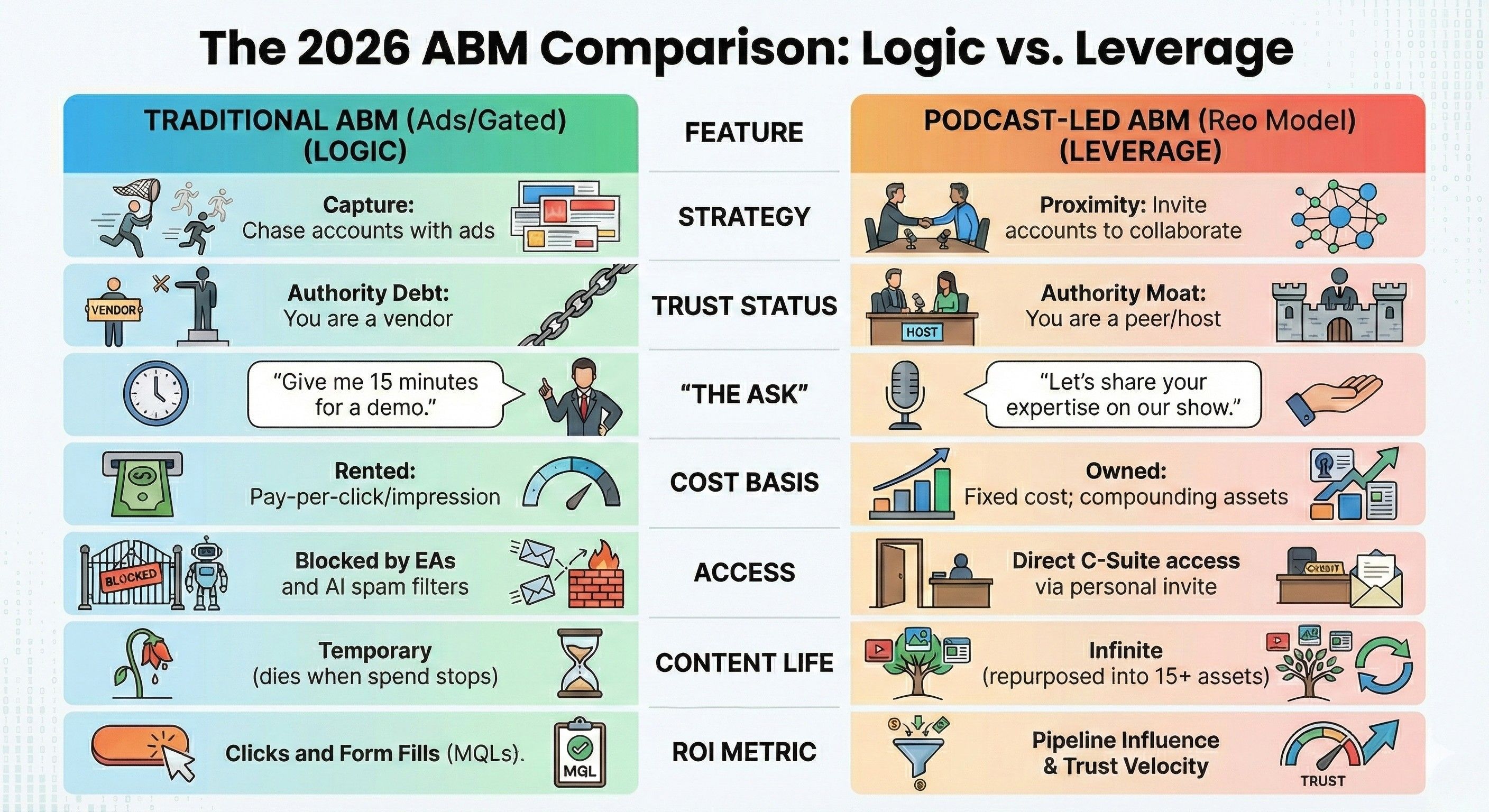
Every ad you run carries an authority debt. In a world of infinite noise, asking for a click is a high-friction request. Because you are asking for a prospect's time before providing a shred of value, you start the relationship in the "red", looking like a solicitor rather than a partner.
2. The Cost Trap
Because trust is low, you have to spend more just to be noticed. Between intent data subscriptions ($20k+), aggressive ad spend, and agency fees, a traditional "Tier 1" ABM campaign can easily burn $15,000/month before a single discovery call is even booked. You are essentially paying a trust tax to bypass the lack of organic credibility.
3. The Filter
Even with a massive budget, you eventually run into the digital fortresses built by C-suite executives. These decision-makers don't download whitepapers and they don't click on banner ads; they listen to their peers. This is the ultimate bottleneck, if you aren't being discussed in the rooms where decisions are made, you simply don't exist.
This is where podcasts move from a nice-to-have to a strategic necessity. A podcast isn't just content, it’s your key to getting inside the fortress.
Good Read: 7 Proven Strategies to Turn Your B2B Podcast Into an ABM Engine
The Psychology of the "Host vs. Salesman"
Looking at the data above, the shift in ROI isn't just a result of a different channel, it’s a result of a different identity. When you move from traditional ABM to a podcast-led model, you fundamentally change how the prospect perceives your brand.
Why does a podcast invitation consistently outperform cold outreach by 3x to 5x? It’s basic human psychology.
When you cold call a CEO, you are an interruption. You are asking them to give up their most valuable resource, time, so you can pitch them. Their guard is up before you finish your first sentence.
When you invite that same CEO to your podcast, you are a collaborator. You are offering them a platform, authority, and a chance to share their worldview. This shift in dynamic removes the friction of the "sale." By the time the 45-minute recording ends, you aren't a vendor on a spreadsheet; you are a peer who has provided them with value.
3 Strategies to Turn Your Podcast into a Revenue Engine
To move from "content experiment" to "growth system," you need a framework that ties back to revenue.
Step 1: The "Reverse Guest Prospecting" Method
Stop inviting "influencers" to chase downloads. Downloads are a vanity metric. Align your guest list 100% with your Sales Team’s Target Account List.
- The Action: Identify 10 dream accounts. Invite their leadership to discuss a specific industry challenge.
- The Revenue Link: The recording is a discovery call in disguise. You hear their pain points, their strategic goals, and their worldview voluntarily.
Step 2: Kill the "Authority Debt"
In B2B, production value is a proxy for product quality. If your video looks like a grainy Zoom call, you are telling the prospect your product is unpolished.
- The Action: Benchmark your video against the top 1%. Use dynamic captions, multi-cam angles, and high-fidelity audio.
- The Result: Professionalism builds trust faster than any whitepaper. It proves you are a market leader before you even mention your features.
Step 3: The Multi-Platform Slice
Don't let your insights die in an RSS feed. This is where you activate the "Content Multiplier Effect." One 45-minute deep dive should yield:
- 3-5 Vertical Clips: High-hook mobile content for the founder’s LinkedIn.
- Text Distillation: An SEO-optimized blog (like this one) and a high-signal newsletter.
- Sales Enablement: Send a 2-minute clip of the founder solving a specific problem to a prospect who mentioned that exact pain point.
The difference between a hobby and a revenue engine is strategy.
Traditional ABM is a treadmill - the moment you stop paying, the growth stops. Podcast-led ABM is a growth system that creates real conversations and an influential pipeline. Most importantly, it brings ABM back to its roots: trust and relationships.
In a world where attention is scarce and trust is fragile, the teams that win will be the ones who show up consistently, listen deeply, and create space for meaningful conversations.
Ready to turn your founder’s voice into a revenue engine?
Book a Reo Strategy Audit and let’s transform your content into a high-performance distribution machine.