
Podcast Guest Outreach That Doesn’t Feel Like Sales
You open your email inbox on Monday morning. Amid the flurry of internal updates and newsletters, you see it. The Subject Line: "A Visionary Guest for Your Show!"
You open it. It’s 500 words long. It reads like a polished resume mixed with a corporate press release. The sender lists their five major accomplishments, their company’s recent funding round, and exactly what they plan to discuss (which, coincidentally is their own product).
It’s the digital equivalent of a hard sales pitch. It's transactional, self-serving, and exhausting. And if you are the host of a top-tier B2B podcast, this email has already been deleted.
For B2B Founders, CMOs, and Heads of Demand Generation, getting booked on relevant podcasts is a powerful positioning tool. But effective B2B Podcast Outreach is a delicate art. It requires a fundamental shift in thinking. You must stop seeing outreach as a sales activity and start seeing it as a networking and partnership activity.
If you are currently executing a pitch that feels like a cold SDR email, you are not just hurting your guest booking strategy, you are damaging your professional brand.
Here is how to master the art of relationship-led outreach that gets you booked, builds genuine network capital, and never ever feels like sales.
The Core Problem with Current B2B Podcast Outreach
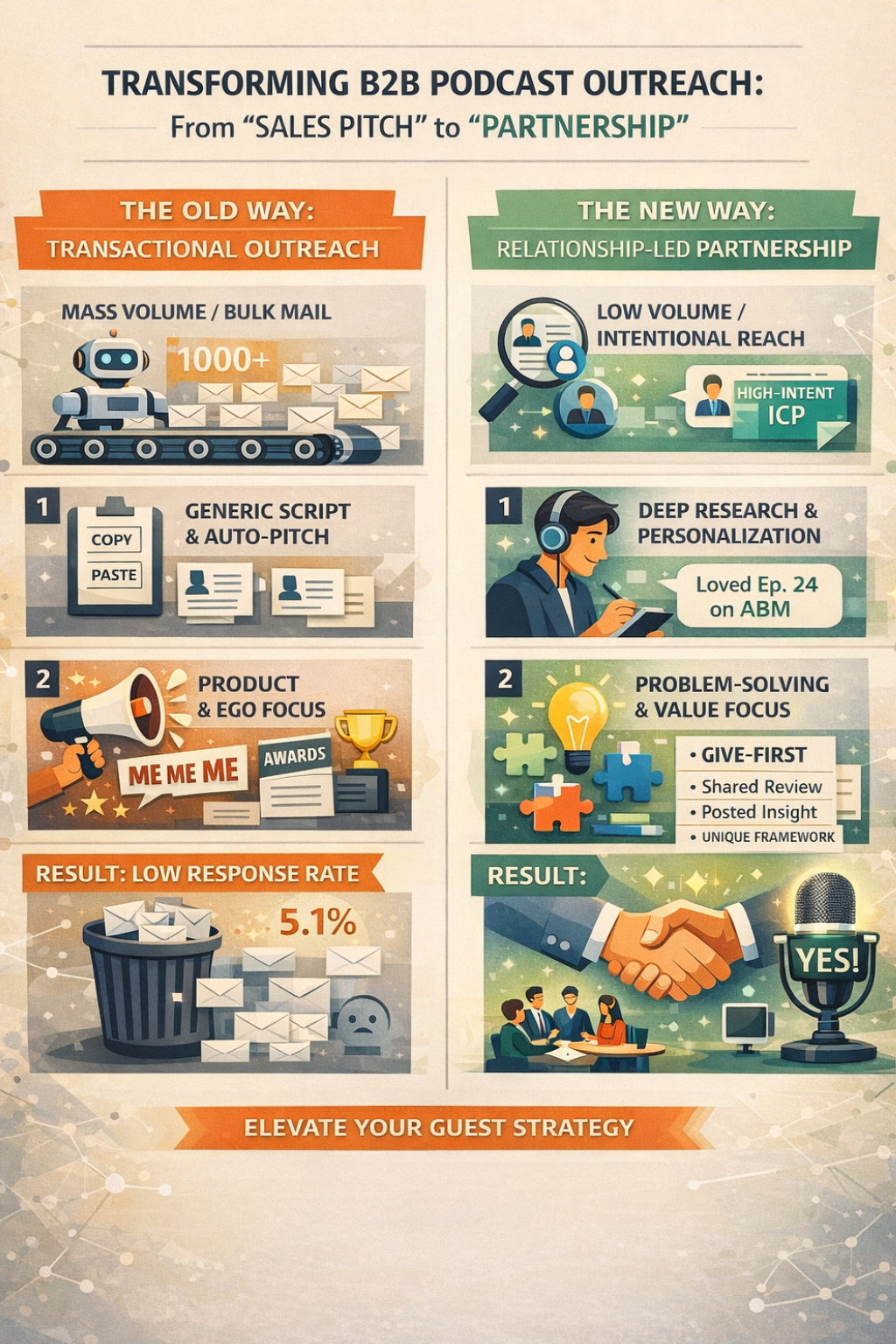
The landscape of B2B content marketing has become oversaturated. Everyone wants to be a thought leader. In fact, recent data analyzing millions of B2B cold emails shows that average outreach response rates have plummeted to just 5.1%. The resulting noise means that treating podcast outreach like a bulk-mail marketing campaign which might have worked five years ago will get you sent straight to spam today.
Hosts of influential B2B shows are fierce guardians of their audience's time. They are not looking to give you free airtime to promote your company. They are looking for strategic, high-value content that solves a difficult problem for their listeners.
When your B2B Podcast Outreach focuses solely on your product’s capabilities or your personal achievements, you are positioning yourself as a vendor looking for a favour. To succeed, you must position yourself as an industry peer offering a valuable resource.
Step 1- Shift Your Mindset from Transacting to Connecting
Before you write a single subject line, you must shift your mental model. The purpose of outreach is not to get booked or to get exposure. The goal is to build a high-value connection with an influential peer (the host) and, by extension, their audience.
This is the foundation of relationship-led growth. View the podcast appearance as the beginning of a strategic partnership, not the endgame. Sometimes, the host might even be a perfect fit for your ABM target list. If you pitch them aggressively on day one, you kill any chance of a future relationship before it starts.
For more on building this kind of networking capital, check out our core philosophy on:
7 Proven Strategies to Turn Your B2B Podcast Into an ABM Engine
Step 2: The Critical Phase – Intense Host and Show Research
A relationship-led approach is impossible without research. If you haven't listened to the show, you cannot pitch the show.
Top hosts will tell you they can spot a generic pitch in the first sentence. They look for signals that you know who they are.
Before you even think about pitching, spend 30 minutes on research:
- Listen to 2-3 recent episodes: Don't just scan the titles. Listen to the interview style. Is it formal? Conversational? Do they have unique segments?
- Review their recent guests: Who else has been on? Are you bringing a perspective that is complementary but different to what they've already covered?
- Find their audience: Where does their audience hang out? What are their recent LinkedIn posts about? This helps you identify the current burning topics in their niche.
Step 3: Crafting the "Give First" Outreach Strategy
This is the most crucial differentiator of non-salesy outreach. You must give before you ask.
Authentic networking is built on reciprocity. If your very first interaction with a host is an email asking them for an hour of their time, you are sending a strong transactional signal.
Instead, build digital rapport before you pitch:
- Engage publicly: Follow the host on LinkedIn. Leave thoughtful, insightful comments on their posts (not just "Great post!").
- Share their content: Share one of their recent episodes with your own network, adding your own specific takeaway. This is powerful social proof.
- Leave a review: Write a genuine, specific review on Apple Podcasts or Spotify. Hosts appreciate this and it provides massive value.
By doing this, you aren't a cold contact. You are an engaged community member and a value-add to their ecosystem.
Step 4: Structuring the Perfect, Value-Driven Pitch
Now you are ready to write the email. The key here is specificity and humility. The email should be about them, not you.
When you articulate your value, you must provide proof. For example, if you claim to be an expert in B2B storytelling, don’t just state it, show how you can teach that concept to their audience through a unique framework or a case study. In this specific scenario, you could even subtly reference relevant concepts in storytelling strategy from an expert, to add authority and context to your own suggested topics.
Anatomy of a High-Converting, No-Sales Outreach Email
A high-performing email follows a simple structure that prioritizes relationships over conversion.
- The Personalized Hook: Reference a specific conversation or moment from an episode you listened to. Show, don’t tell, that you have done your homework.
- The Problem/Topic Pivot: Identify a specific problem their audience is facing that you are uniquely qualified to solve. Make the connection between what they currently cover and your fresh angle.
- The Specific Value Prop: Offer three distinct bullet points outlining the exact takeaways the audience will get. This shows you have a structured plan, not a product story. Use secondary keywords naturally here, perhaps framing your bullet points around a specific guest booking strategy or podcast guest pitch.
- The Humility-Driven Close: This is the non-salesy part. Use a soft close that respects their time and autonomy. "I'm happy to follow up in a few weeks if you are booked out for now. If not, no worries at all—I'll keep listening."
Nurturing the Relationship Post-Recording
If you get booked, congratulations! The non-salesy approach doesn't end there. The most strategic network capital is built after the recording is finished.
Effective B2B Podcast Outreach is about the entire guest life cycle. Be a stellar guest during the interview. Offer high-quality sound and video. Promote the episode heavily on all your channels when it goes live. Thank the host publicly.
This ensures you are a reference-able guest, a strategic asset to their show, and a trusted peer they will want to stay connected with. For a breakdown of what that entire collaborative process looks like, our article on building strategic partnerships is a good place to learn more about.
Redefine Your Guest Strategy
If you want to reach top tier B2B podcasts in 2026, you cannot rely on automated SDR tactics.
Your B2B Podcast Outreach must mature. By shifting your mindset from transactional 'sales' to relational 'partnerships,' doing deep homework, and consistently leading with value, you completely change the dynamic. You stop being a cold contact pitching for a product feature, and you become a respected peer offering an indispensable asset to their show.
Stop pitching. Start connecting. The results will speak for themselves.