
Podcasts Are the Missing ABM Channel B2B Teams Will Rely On in 2026

Account-based marketing was meant to solve a very real problem in B2B:
How do you build meaningful relationships with a small set of high-value accounts in a noisy, crowded market?
Over time, ABM has become expensive, complex, and tool-heavy. More intent data. More personalization layers. More ads. More dashboards. And yet, many B2B teams are still struggling to get the one thing that actually matters: attention from the right people.
As we look toward 2026, something is becoming increasingly clear.
The problem isn’t that ABM doesn’t work.
The problem is that most ABM today has drifted away from what made it effective in the first place: trust and relationships.
This is where podcasts come in.
Not as a content experiment.
Not as a brand play.
But as a relationship-first ABM channel that is cheaper, more human, and more effective than many traditional approaches.
Why Traditional ABM Is Struggling
ABM adoption is at an all-time high. According to a 2023 Demand Gen Report, over 70% of B2B marketers say ABM delivers higher ROI than other marketing initiatives. And yet, many teams quietly admit they’re not seeing the returns they expected.
Why?
Because ABM has become overly mechanized.
Personalization often means swapping company names in emails.
“Intent signals” are interpreted without real context.
Outreach is frequent, but rarely welcome.
At the same time, costs are rising. Paid media is more competitive. Sales cycles are longer. Buyers are harder to reach. Gartner reports that B2B buying groups now include 6–10 decision-makers on average, each with their own priorities and objections.
ABM tools can help you identify accounts. They can help you automate touchpoints. But they cannot manufacture trust.
And trust is the bottleneck.
B2B Buyers Are Tuning Out, Not Leaning In
There’s a growing trust deficit in B2B marketing.
Edelman’s Trust Barometer consistently shows that buyers trust “people like me” and subject matter experts more than brands or advertisements. LinkedIn’s own research reinforces this: content from individuals significantly outperforms content from company pages in reach and engagement.
At the same time, buyers are overwhelmed with content.
Blog posts. Whitepapers. Webinars. Case studies. Ads.
Most of it is skimmed. Much of it is ignored.
What buyers actually respond to is credibility and context. They want to hear how peers think. How operators make decisions. What leaders have learned the hard way.
That’s why conversational formats are winning.
Podcasts aren’t competing with blog posts. They’re competing with cold outreach and low-trust marketing tactics. And they’re winning because they create something ABM desperately needs: time and attention.
Podcasts Solve the Hardest Part of ABM
At its core, ABM is about opening doors into target accounts and building relationships that compound over time.
Podcasts do this unusually well.
A 45-minute conversation creates a level of familiarity that dozens of emails cannot. When you invite someone as a guest, you’re not asking for their time to pitch them. You’re offering them a platform.
That shift in dynamic matters.
Instead of “Can I have 15 minutes of your time?”
It becomes “Let’s talk about your experience and ideas.”
This is why podcast invitations consistently outperform cold outreach in response rates. You’re not interrupting. You’re collaborating.
Once that conversation happens, several things follow naturally:
- A real relationship is established
- Your brand becomes associated with credibility
- Follow-ups feel contextual, not forced
- Content is created that extends beyond the guest
This is ABM, but without friction.
Podcast-Led ABM vs Traditional ABM
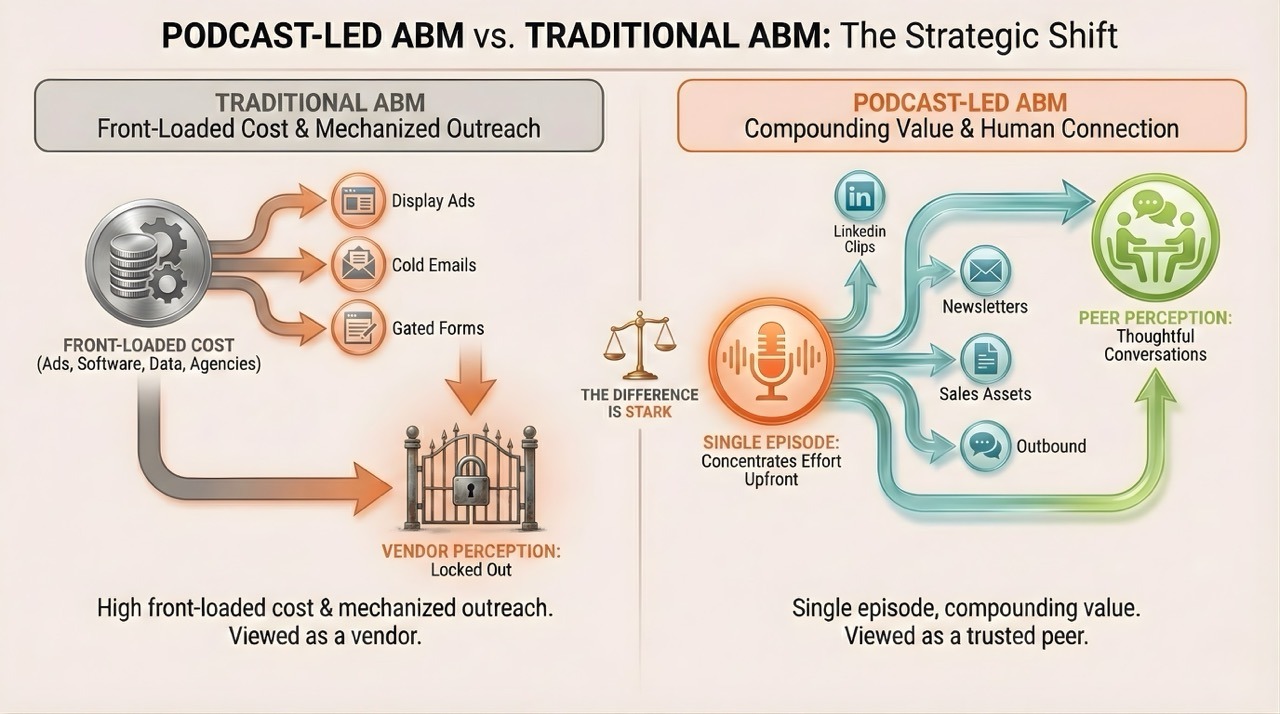
When you compare podcast-led ABM with traditional ABM tactics, the difference is stark.
Traditional ABM is often front-loaded with cost. Ads, software, data providers, and agencies add up quickly. Podcast-led ABM, by contrast, concentrates effort upfront and compounds over time.
A single episode can be repurposed across LinkedIn, email, newsletters, sales enablement, and even outbound. According to HubSpot, multi-channel content strategies significantly outperform single-channel efforts in both engagement and conversion.
More importantly, podcasts change how buyers perceive you. You’re no longer a vendor trying to get in. You’re a peer facilitating thoughtful conversations in the industry.
That positioning is difficult to replicate with ads or emails alone.
How Podcast-Led ABM Actually Works
The most effective podcast-led ABM strategies are intentional, not accidental.
They don’t start with microphones or formats. They start with accounts.
First, you identify your ideal customer profile and the accounts that matter most. Then, instead of targeting them with ads, you invite leaders from those companies to speak about topics they care about.
The conversation itself becomes the relationship anchor.
From there, each episode fuels multiple outcomes:
- Sales teams use episodes as warm follow-ups
- Marketing teams repurpose insights across channels
- Founders build authority by association
- Target accounts engage organically with the content
The key is alignment. The podcast must serve sales, marketing, and brand together. When it does, it stops being a content project and becomes a growth system.
Real-World Signals That This Already Works
We’re already seeing signals that this approach is effective.
Founder-led podcasts are increasingly used to build inbound interest, warm enterprise accounts, and support long sales cycles. LinkedIn engagement around podcast clips has grown sharply over the past two years, particularly in B2B SaaS and developer-focused companies.
More tellingly, many sales conversations today start with content, not demos. “I saw that episode you did” is becoming a common opening line.
As paid channels continue to saturate and outbound effectiveness declines, relationship-based channels will matter more. Podcasts sit at the intersection of trust, content, and conversation.
That’s why 2026 feels like a tipping point.
The Mistakes B2B Teams Will Make With Podcasts
Not every podcast will succeed as an ABM channel.
The biggest mistake teams make is treating podcasts like a branding exercise with no clear intent. Chasing downloads. Interviewing generic guests. Publishing inconsistently.
Another common mistake is focusing only on the show itself and ignoring distribution. Podcasts don’t drive impact because of RSS feeds. They drive impact because of how the conversations are reused and shared.
Finally, many teams underestimate the importance of guest selection. If your guests don’t overlap with your ICP, your podcast becomes content for the wrong audience.
Podcast-led ABM works when it is designed deliberately.
Good Read: 7 Proven Strategies to Turn Your B2B Podcast Into an ABM Engine
What Smart B2B Teams Should Do Now
The teams that will win in 2026 aren’t waiting for perfect conditions. They’re building systems early.
They start with a clear thesis: who the podcast is for and why it exists. They align it with sales goals. They think in quarters, not episodes.
They invest in quality conversations and consistent distribution. And they measure success not just in downloads, but in relationships created, conversations started, and pipeline influenced.
Most importantly, they understand that ABM works best when it sounds human.
Final Thought
ABM has always been about building relationships with the accounts that matter most. Podcasts simply make that easier, more scalable, and more genuine.
In a world where attention is scarce and trust is fragile, the teams that win will be the ones who show up consistently, listen deeply, and create space for meaningful conversations.
That’s what podcasts do best.
And that’s why, in 2026, podcasts won’t be a “nice-to-have” in B2B.
They’ll be one of the most effective ABM channels teams rely on.