
Why Podcasts Are the Best Source of Multi-Channel B2B Content
Staring at a blinking cursor is arguably the most expensive bottleneck in your Go-To-Market strategy.
Right now, your marketing team is likely asking your founders or subject matter experts for "insights" to feed the content calendar. But founders are too busy building the company to write 2,000-word articles. The result? The marketing team defaults to writing generic, surface-level blog posts that no one actually reads.
Traditional content creation starting from a blank page for every single LinkedIn update, blog, or video script is completely broken. It burns out your team, strips away the authentic human voice, and does absolutely nothing to combat rising CAC or historically low buyer trust.
The fix isn't to hire more writers or push your team to brainstorm harder. The fix is to stop authoring content and start extracting it.
Instead of asking, "What should we write today?" you need to ask, “What valuable conversations should we have?”.
At Reo.fm, we don't treat podcasts as just another distribution channel tacked onto the end of a marketing plan.
We view the podcast as the "Hero Asset" - the sun at the center of your content solar system that powers everything else. By shifting from a channel-first approach to a conversation-first approach, you capture the unscripted expertise that B2B buyers actually crave.
In this article, we break down exactly why recorded conversations outperform traditional written formats and how you can turn one single podcast episode into a multi-channel pipeline engine.
The Problem with Traditional B2B Content Creation
Most B2B content strategies are fragmented:
- Blogs written for SEO but not read deeply
- Social posts created in isolation
- Sales content disconnected from marketing
- High production effort for one-time use
This leads to:
- Content fatigue
- Low differentiation
- Weak pipeline connection
Traditional content is often channel-first.
Podcast-led content is conversation-first.
That shift changes everything.
Good Read: Why B2B Podcasts Outperform Gated Whitepapers in 2026
Why Podcasts Create Better Source Content
Unlike written content, podcasts capture unscripted expertise, real opinions, and human nuance, which are far more valuable in B2B decision-making.
Here’s why podcasts outperform other formats:
1. Conversations Generate Depth (Not Surface-Level Content)
A 45-minute conversation naturally produces:
- Original insights
- Real-world examples
- Stories and frameworks
- Authentic tone
This becomes rich “source material” for multiple content formats.
Written-first content often lacks this depth because it starts from a blank page.
2. Podcasts Capture Founder & Expert Voice
In B2B, trust is built through people, not brands.
Podcasts preserve tone, perspective, and credibility, making every repurposed asset feel more human and less generic.
This is especially powerful for:
- Founder-led brands
- Thought leadership positioning
- Category authority building
3. One Episode = Multi-Channel Content Engine
A single podcast episode can generate:
- Long-form blog
- LinkedIn posts and carousels
- Short video clips
- Website content
This dramatically improves content ROI per hour invested.
Research from HubSpot shows that repurposed multi-channel content can drive significantly higher engagement than single-format publishing:
The Podcast-to-Multi-Channel Content Framework
At Reo, we use a simple model:
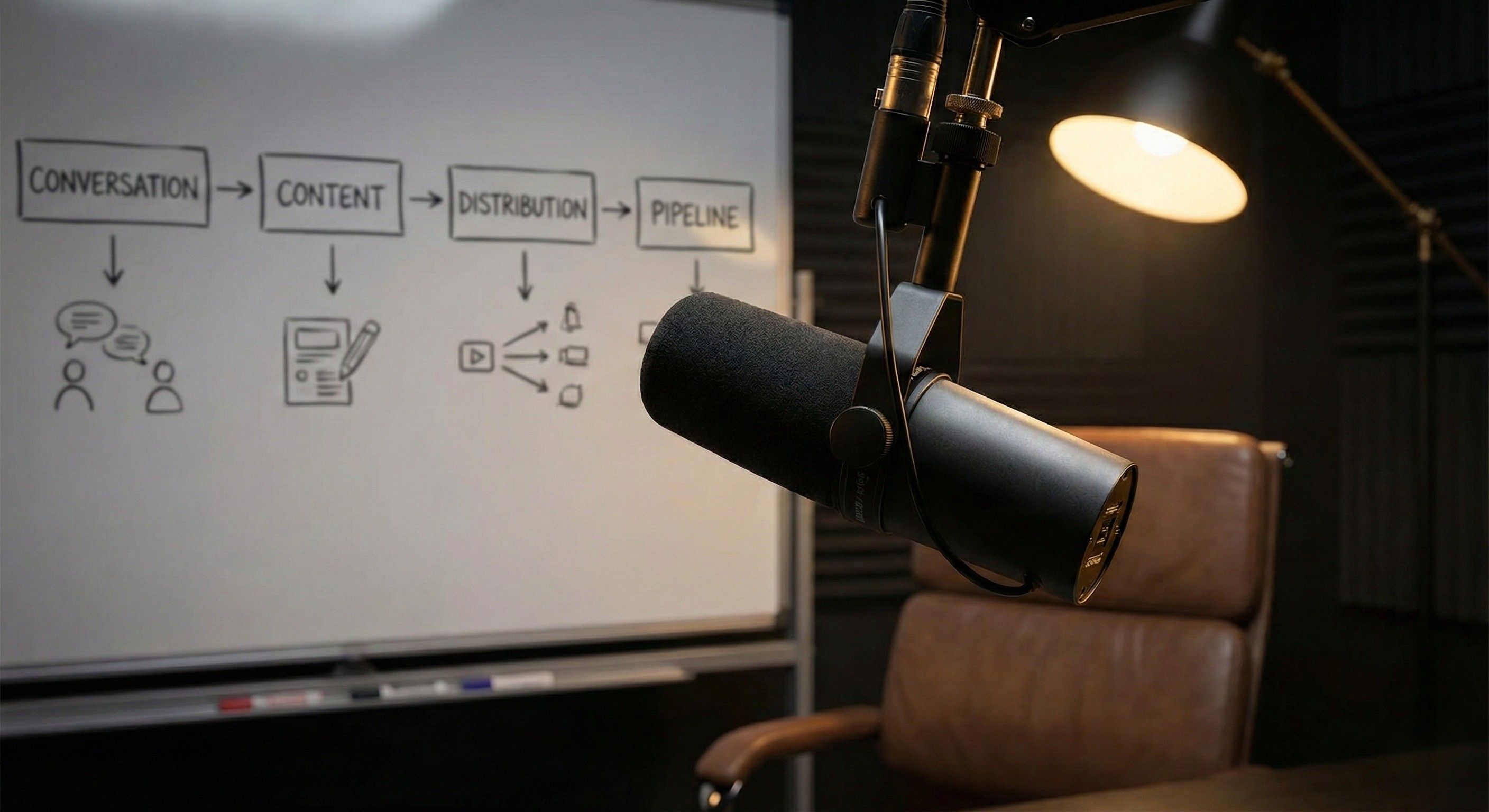
Conversation → Content → Distribution → Pipeline
Here’s how it works.
Step 1: Record the “Hero Conversation”
Start with a high-quality discussion with:
- An ICP leader
- Industry expert
- Customer or partner
This becomes your primary content asset.
Focus on meaningful topics like:
- GTM strategy
- Scaling revenue
- Industry shifts
- Operational challenges
Step 2: Extract Multi-Format Assets
From one recording, create:
Video Assets
- 3-5 short clips for LinkedIn
- YouTube or Shorts format
Written Assets
- SEO blog post
- Thought leadership posts
Sales Enablement Assets
- Conversation-based follow-ups
- Context for target account outreach
This turns a single recording into a multi-channel content engine.
Step 3: Distribute Where Your ICP Actually Lives
Most podcasts fail at distribution, not content.
Multi-channel distribution should include:
- LinkedIn (primary B2B discovery channel)
- Email newsletter
- Sales outreach
- Website blog
- Community or partner sharing
Podcast content performs well because it originates from real conversations, not marketing abstraction.
Step 4: Connect Content to Pipeline
This is where many brands stop, but where real impact begins.
Podcast-led content improves:
- Trust with target accounts
- Warm outreach effectiveness
- Context for sales conversations
- Deal velocity
This transforms content from awareness → pipeline infrastructure.
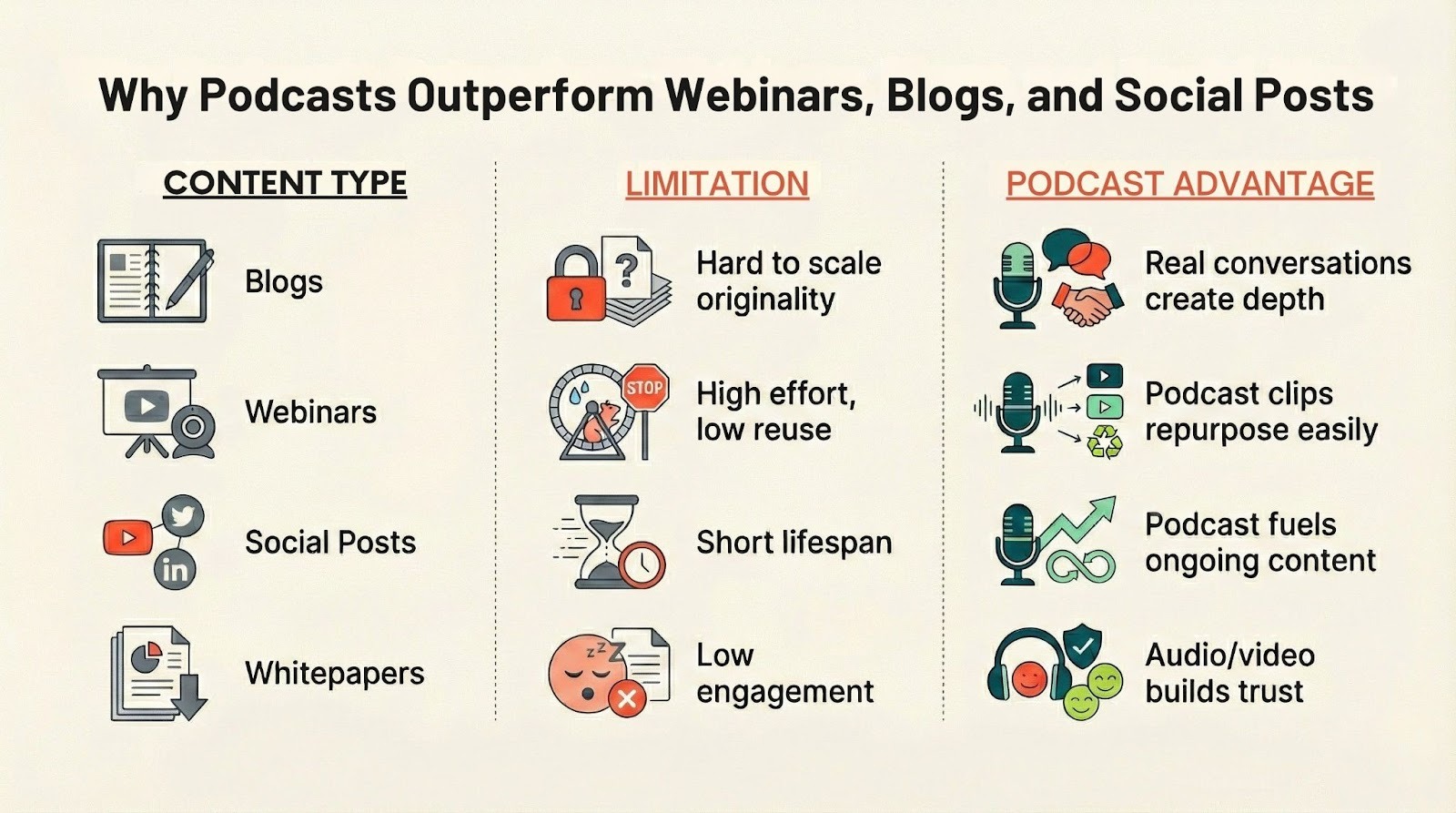
Podcasts are not just a format — they are source content for your entire GTM narrative.
The Strategic Advantage: Content Leverage at Scale
The biggest shift in modern B2B content:
From → Creating more content
To → Extracting more value from conversations
Podcast-led teams don’t chase volume.
They build compounding content systems.
This enables:
- Consistent thought leadership
- Stronger brand authority
- Better pipeline alignment
- Lower content production strain
The secret to a high-performing GTM motion isn't working harder; it's making your content work harder for you. By adopting a podcast-first approach, you ensure that every conversation you have becomes a permanent asset in your sales arsenal. Remember, execution and consistency matter more than perfection.
Ready to turn your podcast into a multi-channel content engine?
Book a Reo.fm Strategy call today