
Why Your B2B Podcast Downloads Don't Matter (And The Metrics That Actually Drive Revenue)

Your CEO just asked the inevitable question, "So, how many downloads did the latest episode get?"
It’s a natural question. We are conditioned to love big numbers. We want charts that go up and to the right.
But what if that question is the exact thing preventing your B2B podcast from becoming a legitimate revenue engine? What if chasing downloads is the equivalent of a sales team celebrating how many cold dials they made, rather than how many enterprise deals they closed?
Here is a hard truth for B2B marketers and founders: Your podcast download numbers are, for the most part, a vanity metric.
They tell you nothing about influence. They tell you nothing about pipeline. And they certainly tell you nothing about revenue.
In 2026, the landscape of B2B influence requires precision, not just volume. If you're running a podcast aimed at engaging C-suite executives and driving strategic growth, it's time to stop worshipping at the altar of download counts and start measuring what actually moves the needle.
The Illusion of Downloads: Why More Isn't Always Better
Let's unpack why the download metric actively misleads B2B podcasting efforts:
- The spray and pray fallacy: High download numbers usually indicate a broad, untargeted audience. For B2B, you don't need everyone to listen; you need the right people to listen. 10,000 downloads from students or junior staff won't close a $100k contract. But 15 highly engaged C-suite listeners from your Target Account List absolutely can.
- The bot inflation: A significant portion of reported downloads across hosting platforms are triggered by bots, automated RSS feeds, or accidental clicks. You are often measuring server pings, not human attention.
- The intent void: A download is a passive consumption metric. It doesn't tell you why someone downloaded it, if they listened past the 30-second mark, or if they're experiencing the specific pain point your SaaS solves.
If downloads are the smoke, we need to find the fire.
The 3 B2B Podcast Metrics That Actually Build Pipeline
If we throw out downloads, what replaces them? You must shift your focus from reach to relationships, and from consumption to conversion.
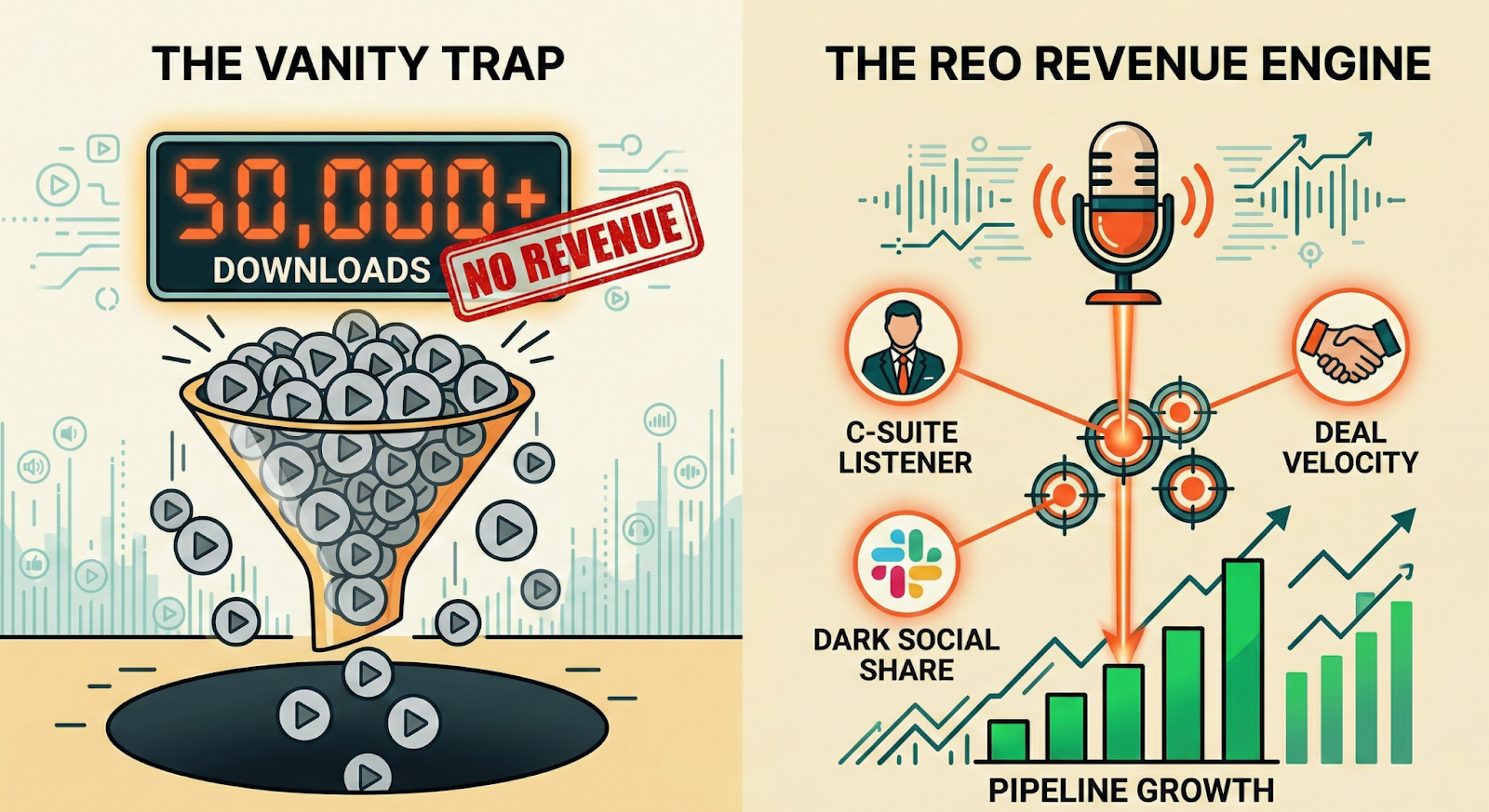
Here is the Reo framework for measuring actual podcast ROI:
1. Deep Engagement (Are they actually listening?)
- Completion rate: This is gold. If 70%+ of your target audience is listening to the end of a 45-minute deep dive, you have captured their attention and earned immense trust.
- Audience retention graphs: Dive into the moments where listeners drop off. Do they bounce during your intro? Do they rewind when you share a specific framework? This behavioral data dictates your future content strategy.
2. Network Influence (Are you building authority?)
- Dark social mentions & direct shares: When a target executive tags your founder on LinkedIn or shares a specific episode clip with their team via Slack, that is a direct signal of influence. According to Gartner's B2B buying journey research, this peer-to-peer sharing in dark social is where the actual buying decisions are shaped.
- Guest caliber: Are you consistently attracting high-tier guests (VPs and C-Suite) from your target accounts? Your ability to book these guests is a leading indicator of your market authority.
3. Pipeline Velocity (The ultimate judge)
Your podcast isn't just a media asset; it is a strategic ABM tool.
- Attributed discovery calls: How many guests from your reverse prospecting strategy converted the podcast recording into an active sales opportunity?
- Deal velocity: Are deals involving prospects who've engaged with your podcast closing faster? (Spoiler: The trust built through authentic conversation drastically shortens sales cycles).
- Sales enablement usage: How often is your sales team sending 2-minute clips of your podcast to unstick stalled deals, and what is the reply rate when they do?
Real-World ROI: Moving from Noise to Pipeline
Let's look at how shifting the metric shifts the revenue.
Example 1: The "Unicorn" SaaS Company
A mid-market logistics AI company was struggling to break into enterprise accounts. Their podcast had decent vanity metrics (2,000 downloads per episode), but zero measurable impact on pipeline.
They shifted their strategy entirely. They stopped chasing industry influencers and started inviting VPs of Logistics from their Top 50 Target Accounts onto the show to discuss their specific supply chain bottlenecks.
- The old metric: 2,000 anonymous downloads.
- The new metric: 15 highly engaged Target Account listeners, 4 LinkedIn shares from their guests, and a 100% meeting booked rate with the guests post-recording.
- The result: Within 6 months, they closed 3 new enterprise deals directly attributed to these podcast conversations, totaling over $1.5M ARR.
Example 2: The Multi-Platform Slice
A B2B fintech firm realized their 60-minute episodes were great for existing users, but too long to capture the attention of net-new CFOs. They began meticulously slicing each episode into high-value, 60-second vertical clips addressing highly specific financial pain points.
- The old metric: RSS feed subscribers.
- The new metric: Reply rates to personalized sales outreach. Their reps started sending these 60-second clips directly to target CFOs via LinkedIn DMs.
- The result: The sales team saw a 2x increase in meeting acceptance rates when a relevant podcast clip replaced their standard text-based cold outreach.
The Reo Method: From Vanity to Velocity
Chasing downloads is a treadmill. You exert a massive amount of effort, but you stay in the exact same place.
Podcast-led ABM—built on intent-driven strategies and a relentless focus on revenue-aligned metrics—is a true growth system.
If you want to understand exactly how to implement the "Reverse Prospecting" and "Multi-Platform Slice" methods mentioned above, read our full breakdown here:
[Podcast ABM vs. Traditional ABM: Cost, Trust, and ROI Compared]
At Reo, we believe that in a world where attention is scarce, the teams that win are the ones who stop broadcasting to everyone and start building bridges with the right ones. It’s time to stop counting downloads, and start counting pipeline.
Ready to turn your podcast into a revenue engine?
Book a Reo Strategy Audit today.