
How Founders Can Use Podcasts to Build Trust Before the First Sales Call

Most founders don’t lose deals because their product is weak.
They lose deals because trust is missing when the first sales call begins.
Today’s B2B buyers are more informed, more skeptical, and more self-directed than ever. By the time they agree to a call, they’ve already formed opinions about your credibility, your thinking, and whether you’re worth their time. Traditional content like blogs, ads, and gated PDFs often fails to influence this moment because it lacks one critical ingredient - human presence.
This is where podcasts quietly outperform almost every other content format.
A founder-led podcast allows prospects to hear how you think, how you explain complexity, and how you respond to real questions, long before a sales conversation happens. The result? Sales calls that start warmer, move faster, and focus on fit rather than persuasion.
In this post, we’ll break down how founders can use podcasts specifically to build trust before the first sales call, why this matters in modern B2B buying journeys, and how to execute it without turning your podcast into a sales pitch.
Why Trust Before the First Call Matters More Than Ever
B2B buying has shifted decisively away from seller-led discovery.
Buyers now:
- Research independently
- Shortlist silently
- Enter sales conversations with pre-formed beliefs
Research shows that podcasts don’t just build awareness, they actively influence decisions, with nearly two-thirds of listeners saying podcast recommendations have directly led them to make a purchase, highlighting the trust built through long-form audio.
If trust isn’t established early, the first call becomes defensive. Founders spend time proving credibility instead of discussing outcomes, constraints, and alignment.
Podcasts change this dynamic because they operate upstream of sales.
Unlike written content, podcasts create asymmetric intimacy. A buyer may spend 30–45 minutes listening to you think out loud, without you knowing they exist. That familiarity reduces uncertainty and makes the first live interaction feel like a continuation, not an introduction.
This isn’t about branding or awareness. It’s about pre-selling trust.
Where This Fits in a Founder’s GTM Strategy (The Reo Perspective)
At Reo, we look at podcasting as a progressive system, not a one-size-fits-all tactic.
Trust comes before targeting. Targeting comes before revenue.
Before podcasts can drive ABM or pipeline directly, they must first do one job exceptionally well - make buyers feel safe engaging with you.
This blog focuses intentionally on the first stage of that journey.
(For founders looking to operationalize podcasts for named accounts and pipeline influence, we break that down separately in our guide on turning a B2B podcast into an ABM engine.)
How Founders Can Use Podcasts to Build Trust Before Sales
1. Design Episodes Around Buyer Anxiety, Not Your Product
Trust is built when buyers feel understood.
Instead of planning episodes around features or announcements, anchor them around,
- Decisions buyers are afraid of making
- Risks they don’t want to own internally
- Tradeoffs they’re unsure how to evaluate
When a podcast helps a listener think more clearly, authority follows naturally.
2. Use the Founder’s Voice — Literally
Founder-led podcasts outperform brand-led shows in early trust-building because buyers don’t trust logos, they trust people.
Your job as a founder isn’t to sound polished. It’s to sound clear.
Explaining,
- Why you believe what you believe
- How you’ve changed your mind over time
- What you’d do differently if starting today
These moments signal maturity and credibility in ways no case study can.
3. Go Long-Form to Prove Depth
Trust doesn’t come from soundbites.
A 30–45 minute conversation allows listeners to assess,
- How deeply you understand the problem
- Whether your thinking holds up under nuance
- If your perspective feels earned or rehearsed
Depth is the differentiator - especially in crowded B2B categories.
4. Bring in Peers, Not Just Customers
Early trust is amplified by association.
Inviting,
- Operators in the same market
- Buyers with real constraints
- Founders solving adjacent problems
creates credibility through context. You’re not claiming expertise, you’re demonstrating it through conversation.
5. Let Sales Calls Reference the Podcast (Naturally)
One of the strongest trust signals happens off the podcast.
When prospects say,
- “I heard your episode on…”
- “Your take on X really resonated”
- “I feel like I already know how you think”
the power of the podcast becomes visible. This is the compounding effect founders underestimate.
Good Read: Podcast ABM vs Traditional ABM: Cost, Trust, and ROI Compared in 2026
A Quick Framework of How Podcasts Mature at Reo
To place this strategy in context, here’s how we think about podcast impact at Reo:
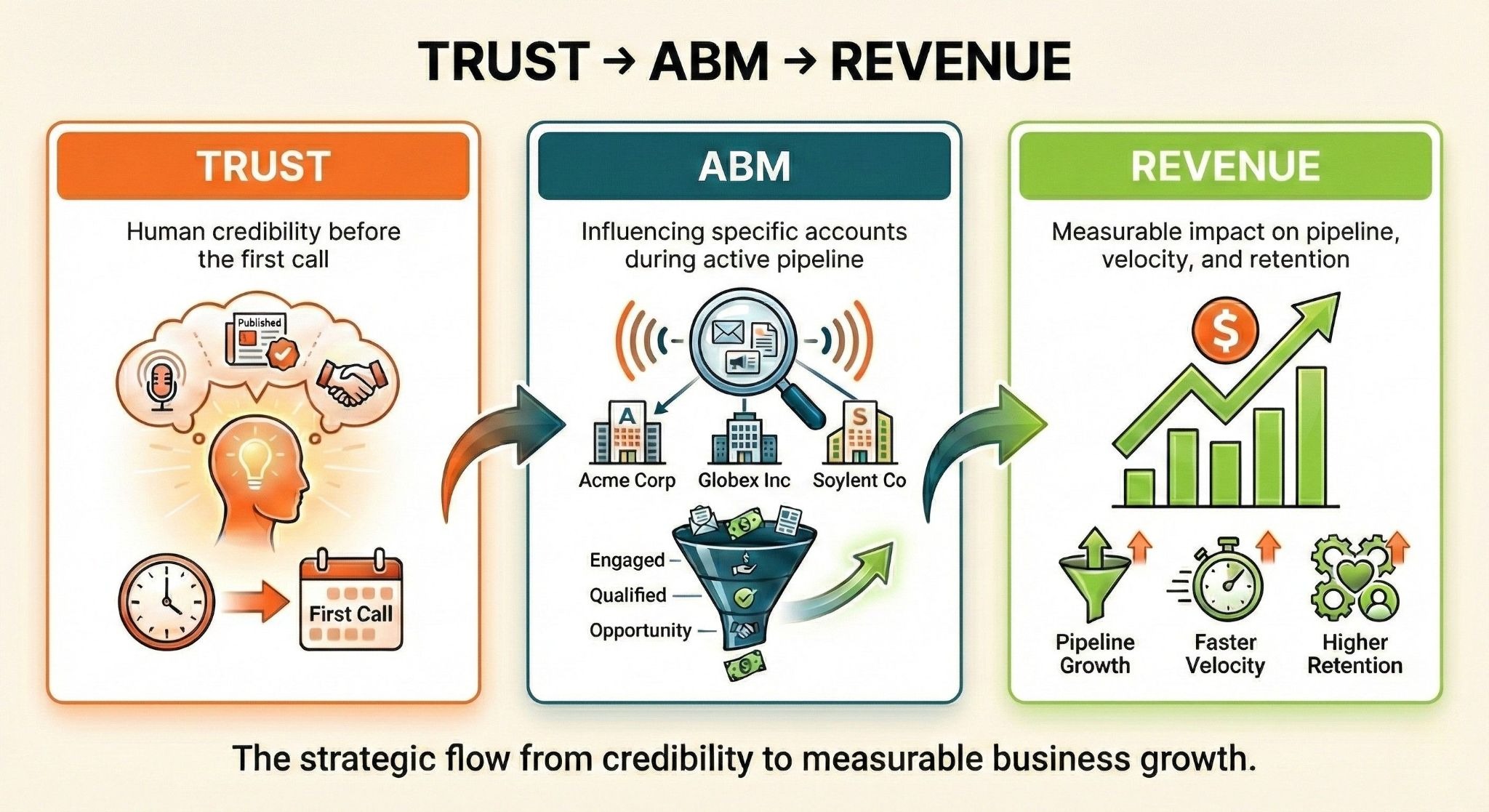
This blog post focuses deliberately on Trust because without it, the later stages underperform or fail entirely.
Common Mistakes Founders Make at This Stage
- Treating the podcast like a demo
- Optimizing for downloads instead of resonance
- Overproducing instead of being consistent
- Expecting attribution before trust exists
Podcasts don’t replace sales. They prepare buyers for better sales conversations.
Trust Is the Real Conversion
The best founder podcasts don’t convince. They clarify.
They make buyers feel smarter, safer, and more confident before a calendar link is ever clicked. When that happens, sales stops feeling like persuasion and starts feeling like alignment.
Conclusion
If you’re running a podcast or considering one and want to understand where it fits in your GTM motion, we help founders map podcasts to trust, ABM, and revenue outcomes.
→ Book a Reo Podcast Strategy Audit
We’ll show you exactly how to evolve your podcast based on where your business is today.