
From Podcast to Pipeline: How B2B Teams Should Measure Podcast ROI

If you are a B2B founder, you have likely stared at your podcast dashboard and asked yourself the same nagging question: "Is this actually working?"
You see the download chart creeping up. You see a few likes on LinkedIn. But when you look at your revenue numbers, the line isn't quite as clear.
This is the "Valley of Death" for B2B podcasts. Most companies treat their show like a media asset obsessing over download counts, CPM (Cost Per Mille), and reach. But you aren't a media company selling ad space; you are a B2B company selling high-value solutions.
At Reo.fm, we believe that for B2B founders, a podcast isn't just a broadcast channel. It is a business development engine.
If you are judging your success solely by Spotify metrics, you are likely undervaluing your show’s impact on your bottom line. It is time to stop measuring your podcast like a YouTuber and start measuring it like a CRO.
Here is the definitive guide to measuring B2B Podcast ROI.
The Vanity Metric Trap
The biggest mistake B2B teams make is confusing Audience with Pipeline.
In the consumer world, 10,000 downloads is a modest start. In the B2B world, 10,000 downloads is often irrelevant if none of those listeners can buy your product. Conversely, 100 downloads from the right VPs of Engineering or Heads of Sales can generate millions in Annual Recurring Revenue.
Why Standard Analytics Fail B2B
Standard hosting platforms (like Anchor, Libsyn, or Transistor) provide "vanity metrics." They tell you how many people listened, but they cannot tell you who listened or why it matters.
Furthermore, B2B buying journeys are non-linear and famously plagued by Dark Social.
- A prospect listens to your episode on their commute.
- They saw a clip of it on LinkedIn two weeks later.
- Three months later, they have a budget approval and type your URL directly into their browser.
Google Analytics will attribute that sale to "Direct Traffic." Your podcast hosting provider won't see it at all. If you rely on these tools alone, your podcast ROI looks like zero, even when it was the primary driver of the deal.
The Reo Framework: 3 Tiers of B2B Podcast ROI
To capture the true value of your show, you need a new framework. We break podcast ROI down into three distinct tiers: Direct Revenue, Attribution, and Content Asset Value.
Tier 1: Direct Revenue ROI (The "Guest-to-Pipeline" Motion)
This is the most overlooked but most potent source of ROI for B2B founders. Your podcast is a networking tool that allows you to have 45-minute conversations with your Ideal Customer Profile (ICP) without being "salesy."
If you invite a prospect to be a guest, you are building a relationship, not just an episode.
How to Measure It:
Metric: Guest Conversion Rate.
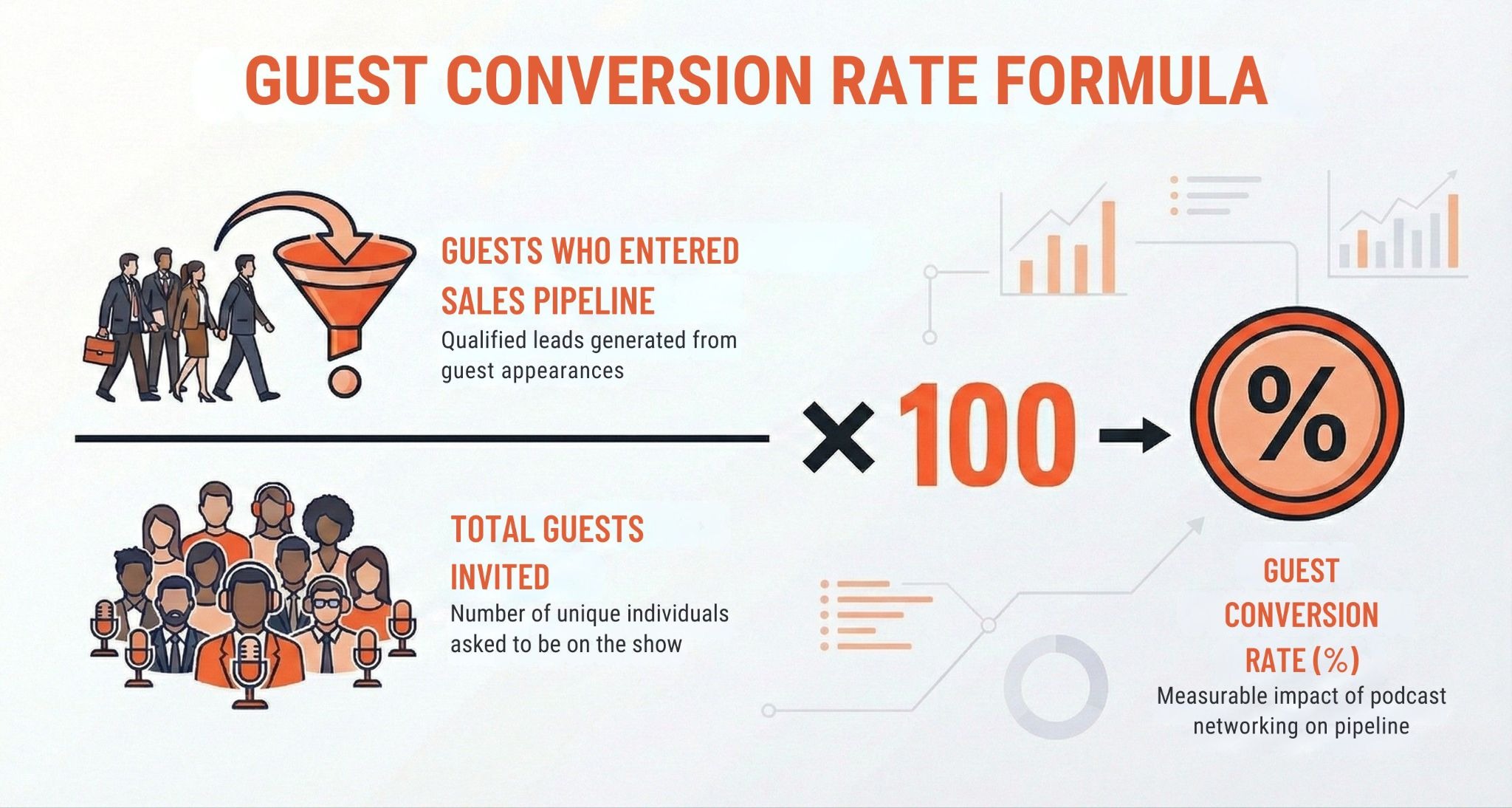
Where to Track: In your CRM (HubSpot/Salesforce), tag every podcast guest with a specific "Campaign Source."
Track their movement from Podcast Guest → Opportunity → Closed Won.
Tier 2: Attribution ROI (The "Listener-to-Lead" Motion)
This tier captures the "Dark Social" impact - the people listening who you didn't interview. Since digital tracking (cookies/pixels) often fails here, you must rely on Zero-Party Data (data the customer voluntarily gives you).
How to Measure It:
- Metric: Self-Reported Attribution.
- The Tactic: Add an open-text field to your demo request or contact form that asks: "How did you hear about us?"
- Why it works: Drop-down menus are restrictive. An open text field allows a prospect to say, "I heard your CEO on the [Show Name] podcast talking about supply chain logistics."
- Valuation: Assign a dollar value to every lead that explicitly mentions the podcast.
Tier 3: Content Asset ROI (The Efficiency Motion)
Marketing is expensive. Creating high-quality LinkedIn posts, newsletters, and blog articles requires time and money. A podcast acts as a "content waterfall," providing source material for all other channels.
How to Measure It:
- Metric: Cost Savings & Engagement.
- The Calculation: Compare the cost of producing one episode versus the cost of hiring a copywriter or agency to create 10 LinkedIn posts, 2 blog articles, and 3 video clips from scratch.
- Bonus Metric: Sales Enablement Velocity. Track how often your sales team uses specific episodes to handle objections. If sending an episode shortens a sales cycle by two weeks, that is measurable ROI.
Practical Implementation: Your Measurement Stack
You don't need a data science team to start tracking this. You just need to set up your infrastructure correctly.
- Modify Your CRM: Create a custom property for "Podcast Guest" status.
- Update Your Forms: Replace "Where did you find us?" dropdowns with "How did you hear about us?" text fields.
- Qualitative Listening: Pay attention to sales calls. If a prospect says, "I loved what you said about X in the last episode," that is a signal that your content is nurturing leads through the Middle of the Funnel (MOFU).
Good Read: How Founders Can Use Podcasts to Build Trust Before the First Sales Call
Real-World Scenarios: What Success Actually Looks Like
Let’s look at two hypothetical scenarios to illustrate why mindset matters.
Scenario A: The "Influencer" Approach
- Downloads: 15,000 per month.
- Audience: mostly students and entry-level employees.
- Revenue Attributed: $0.
- Verdict: High vanity, low value.
Scenario B: The "Reo" Approach
- Downloads: 300 per month.
- Audience: C-Suite executives in your niche.
- Action: You interviewed 10 potential clients; 2 of them signed contracts worth $50k each.
- Revenue Attributed: $100,000.
- Verdict: Low vanity, massive ROI.
Conclusion
Podcasting is not a brand awareness play; it is a pipeline play.
When you shift your focus from "getting famous" to "getting business," the metrics change. You stop worrying about going viral and start focusing on having high-quality conversations that convert.
Are you ready to stop shouting into the void and start building a pipeline?
We specialize in helping B2B founders turn their audio content into a measurable revenue asset. We handle the strategy and production so you can focus on closing the deals that come from it.