
Turn Your Podcast Into a Pipeline: Generating 30+ Assets for LinkedIn, Email, and Sales
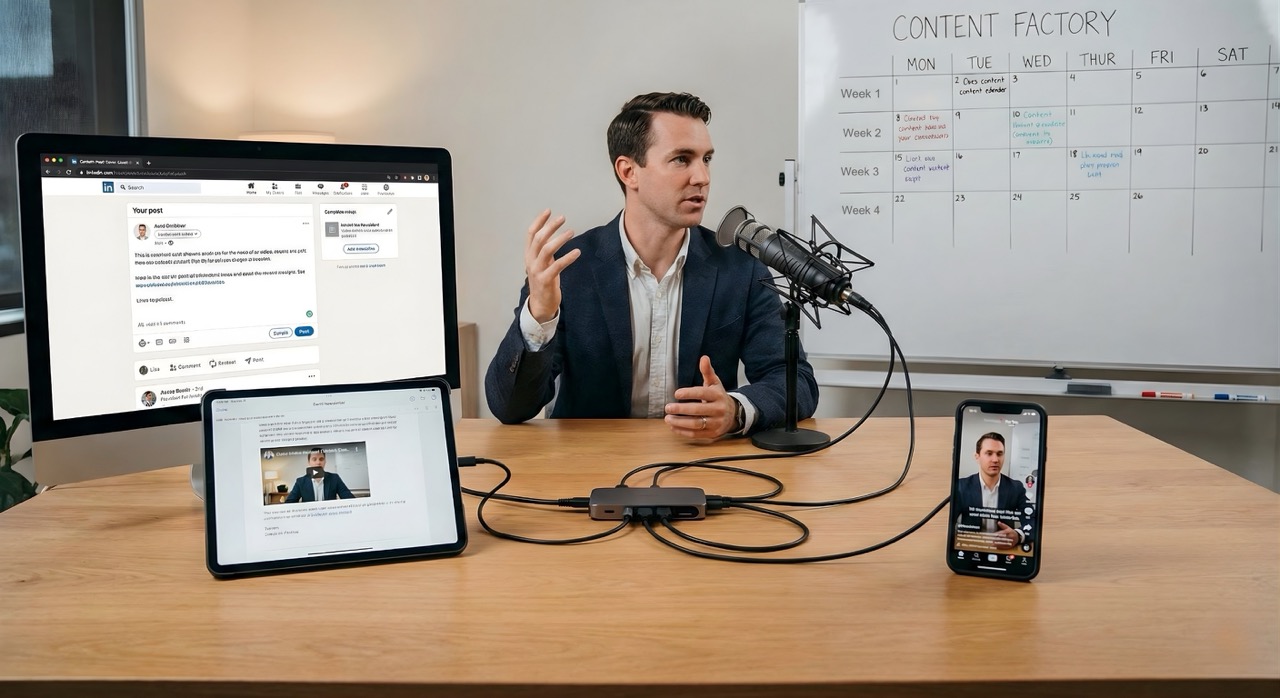
There is a lie that pervades the B2B marketing world. It’s the idea that to build a pipeline, you need to be a "creator."
You are told to wake up early to write LinkedIn hooks. You are told to draft weekly newsletters from scratch. You are told to film TikToks in your car.
If you are a B2B founder or marketing leader, this is terrible advice. You are not a creator; you are a business builder. Your time is worth $500, $1,000, or $5,000 an hour. Spending three hours agonizing over a single text post that has a shelf life of 24 hours is not just inefficient - it is negligent.
The problem isn't that you need less content. You actually need more volume to compete in today's algorithmic feeds. The problem is your production model.
Most companies rely on "Linear Creation" - one idea equals one post. This is unscalable.
B2B SaaS companies winning right now, the ones dominating share of voice and pipeline, operate on a "Compound Creation" model. They treat content as a manufacturing process.
At Reo.fm, we call this The Content Factory.
The premise is simple but transformative:
Record once. Distribute everywhere.
By investing just 45 minutes into a single high-signal podcast conversation, you can generate the raw materials for an entire month of marketing and sales activity. Here is exactly how we turn one episode into 30+ tangible business assets.
The High Cost of Linear Creation
Before we break down the assets, we have to look at the math of your current strategy.
In a traditional "Linear" model, a founder attempts to delegate thought leadership. You spend an hour briefing a freelancer or agency, you wait a week, and you receive a blog post that sounds technically correct but lacks your specific expertise. You then spend another two hours rewriting it.
- Time spent: 4+ hours (Briefing, reviewing, and fixing "fluff").
- Output: 1 Blog Post.
- Distribution: Posted once on the website, maybe shared once on LinkedIn.
- Result: A spike in traffic for 48 hours, then silence.
This is the Efficiency Gap. You are trading high-value executive time for low-leverage assets. Even when you outsource the writing, you cannot outsource the thinking, and the transfer of knowledge is where the friction lies.
Now, consider the Content Factory model.
- Time spent: 45 minutes (Recording a conversation).
- Output: 30+ Assets (Video, Text, Email, Sales Collateral).
- Distribution: Omnichannel presence for 30 days.
- Result: Compounding authority, multiple touchpoints, and sales enablement material that lasts forever.
The podcast isn't the "end product." The podcast is the source code. It is the raw ore that we mine to find the gold. When you stop trying to "brief" and start "speaking," you bypass the friction of creation. You can speak 150 words per minute, but you can likely only type 40 words per minute (of high-quality thought).
The most efficient way to get ideas out of your head and into the market is through a 45-minute conversation.
Manufacturing 30 High-Signal Assets
When we say 30 assets, we don't mean 30 low-quality tweets. We mean high-signal, platform-native content designed to move a prospect from unaware to booked meeting.
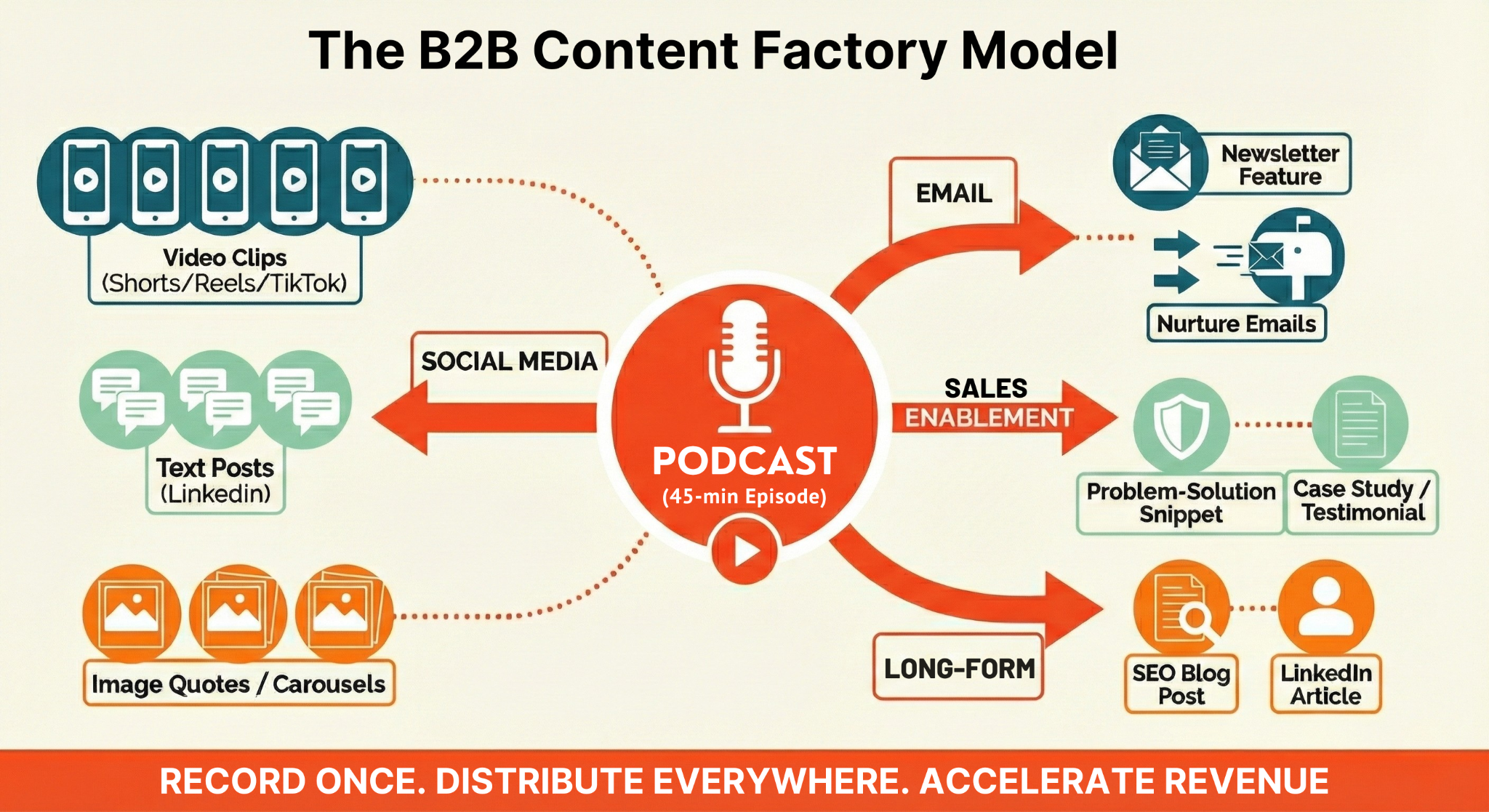
Here is the exact inventory list we generate from a single 45-minute episode.
1. Social Media: The Feed Dominance Layer (13 Assets)
Social platforms are top-of-funnel (TOFU). Your goal here is to stop the scroll and earn attention. Because the podcast is 45 minutes long, we have enough depth to extract multiple angles.
5x Short-Form Video Clips (Shorts/Reels/TikTok):
We don't just chop up random sentences. We hunt for the "Aha!" moments. The contrarian takes. The tactical frameworks. We package these into 60-second vertical videos with dynamic captions. These are your viral hooks.
5x Text-Based LinkedIn Posts:
Video is great, but text still rules LinkedIn for authority. We take the transcript and ghostwrite 5 distinct posts. One might be a story, one might be a listicle, one might be a hot take. These read like you spent hours writing them, but they are just polished versions of what you already said.
3x Image Quotes / Carousels:
We extract the most punchy one-liners ("The one thing killing your SDR team is...") and turn them into branded visual assets. These are high-shareability assets that reinforce your brand visual identity.
2. Email Marketing: The "Nurture" Layer (3 Assets)
Most B2B newsletters are boring because they are curated links or generic updates. Yours will be different because it is based on exclusive conversation.
1x Deep-Dive Newsletter Feature:
We turn the core theme of the episode into an editorialized newsletter. This isn't "Hey, listen to the pod." This is a value-rich article delivered to their inbox, with the option to listen if they want more.
2x Direct Nurture Emails:
These are the most underrated assets. These are plain-text emails designed for your sales sequences.
Example: "Hey [Name], I know you're looking at solving [Problem]. I just had a chat with [Guest] about this exact issue, and they dropped a framework at the 20-minute mark that I think would help you. Here’s the clip."
3. Sales Enablement: The Revenue Acceleration Layer (2+ Assets)
This is where the Content Factory pays for itself. Marketing creates the air cover; Sales captures the ground. We turn your podcast into weapons for your sales team.
1x "Problem-Solution" Snippet:
In a 45-minute episode, you will inevitably solve a specific problem. We isolate that specific 2-minute segment. When a sales rep hears that objection on a call, they don't have to argue; they just send the clip. "Here is how we think about that."
1x Case Study Asset (Social Proof):
If your guest is a client or partner, this episode is a living testimonial. We extract the "Before and After" story to prove your ROI to future prospects.
4. Long-Form Content: The SEO Layer (2 Assets)
Social media disappears; search traffic compounds.
1x SEO-Optimized Blog Post:
We don't lazy-post the transcript. We write a structured, 1,000-word article targeting specific keywords derived from the conversation. This drives organic traffic for years, not days.
1x LinkedIn Article:
A native article on LinkedIn helps you rank internally on the platform and establishes deep thought leadership for those vetting your profile.
Good Read: Podcasts Are the Missing ABM Channel B2B Teams Will Rely On in 2026
Converting Content Into Sales Signals
Why does this specific mix of assets work? Because it creates Sales Signals.
In B2B sales, "Trust" is the currency. When a prospect sees a text post from you on Tuesday, watches a video clip on Wednesday, and receives a newsletter on Thursday, you are manufacturing familiarity (The Mere Exposure Effect).
But beyond familiarity, you are demonstrating Competence.
When you create content linearly, you often stick to surface-level advice because deep writing is hard. When you record a 45-minute podcast, you go deep. You explore nuances. You debate with your guest.
This results in High-Signal Content.
When a prospect consumes this content, they aren't just being entertained; they are auditing your expertise. By the time they book a demo, they already know:
- How you speak.
- How you think.
- That you understand their specific problems.
We call this Pipeline Velocity. Assets generated from podcasts tend to shorten sales cycles because the education phase happens before the sales call, not during it.
Why You Cannot Build This Alone
If the "Content Factory" model is so obvious, why doesn't everyone do it?
Because execution is hard.
To turn one video into 30 assets, you need a specific stack of skills:
- Video Engineering: Color grading, audio mixing, multi-cam editing.
- Copywriting: Translating spoken word into reading word (without losing the voice).
- Graphic Design: Maintaining brand guidelines.
- Strategy: Knowing which 60 seconds of a 45-minute clip will actually convert.
Most founders try to hire a Virtual Assistant to do this. The result is usually poorly captioned videos and generic AI-written posts that damage the brand. Others try to do it themselves and burn out after three episodes.
This is where Reo.fm comes in.
We provide the infrastructure of a full media production house for a fraction of the cost of hiring a team.
- You show up for a 45-minute conversation (remote or in-studio).
- We record high-fidelity audio and video.
- We process the raw file through our strategy engine.
- We deliver 30+ ready-to-post assets to your inbox (or post them for you).
We don't just "edit." We hunt for revenue. We identify the clips that will open doors. We write the posts that will start conversations in the DMs.
Choose Between the Treadmill and the Factory
You have a choice in how you build your pipeline this year.
You can stay on the Content Treadmill. You can wake up every day wondering what to post, fighting the algorithm, and hoping something sticks. You can continue to trade your founders' time for "likes."
Or, you can build a Content Factory.
You can spend 45 minutes a week having interesting conversations with smart people. You can let a system turn that conversation into an omnipresent media strategy. You can arm your sales team with the best collateral in the industry.
The "Record Once, Distribute Everywhere" model isn't just a marketing tactic; it is an operational leverage play. It is the only way to scale your voice without scaling your hours.
Stop shouting into the void. Start building an engine.
Ready to build your Content Factory?
At Reo, we specialize in helping B2B founders turn conversations into revenue. Let us show you exactly what your pipeline could look like with a factory behind it.
Book a Strategy Session with Reo.