
Why Most B2B Podcasts Fail (And How to Avoid It)

It's not the content. It's not the production quality. It's the strategy or the lack of one.
Here's a stat that should make you uncomfortable: most B2B podcasts don't make it past episode 10.
Not because the founder ran out of things to say. Not because the production was bad. They die because nobody thought about what the podcast was for before hitting record.
We've helped B2B SaaS companies launch and run podcasts that generate real pipeline. We've also seen enough failed shows to know exactly why they fail. Here are the five most common reasons and what to do instead.
Failure #1: Treating the Podcast as a Content Play
This is the biggest killer. A marketing team decides "we should have a podcast" because it feels like the right thing to do. They hire an editor, record a few episodes, publish them to Spotify, and wait for something to happen.
Nothing happens.
Why it fails: A podcast without a commercial strategy is just another content format competing for attention. And in 2026, attention is the most expensive resource in B2B.
What to do instead: Define the podcast's job before you record a single episode. Is it an ABM channel to build relationships with target accounts? A founder authority platform? A sales enablement tool? The answer determines your guest strategy, your topics, your distribution, and how you measure success.
Failure #2: Optimising for Downloads
Downloads are the vanity metric of B2B podcasting. A B2B podcast with 200 listeners per episode can generate more pipeline than a consumer podcast with 10,000 - if those 200 listeners are your ICP.
Why it fails: When you chase downloads, you start booking guests for their audience size instead of their strategic value. You write clickbait titles. You broaden your topics to appeal to everyone. And you lose the specificity that makes B2B content valuable.
What to do instead: Track the metrics that actually matter. How many podcast guests turned into qualified conversations? How many clips drove engagement on LinkedIn? How many sales reps are using episode content in their outreach? Pipeline generated is the only metric that keeps a B2B podcast funded.
Good Read: From Podcast to Pipeline - How B2B Teams Should Measure Podcast ROI
Failure #3: The Founder Disappears After Month Two
Launching a podcast is exciting. Maintaining one is work.
Most founder-hosted podcasts follow the same arc: enthusiastic first five episodes, increasingly delayed recording sessions, and eventual silence. The founder got busy. Other priorities won.
Why it fails: Without a system that minimises founder time, the podcast competes with everything else on the CEO's calendar and it loses.
What to do instead: Design the system so the founder's only job is showing up for the conversation. Everything else — guest booking, prep, editing, distribution, repurposing — should be handled by a team or an agency. When the total time commitment is 45 minutes per episode (just the recording), consistency becomes sustainable.
Failure #4: No Repurposing Strategy
Recording an episode and publishing it to Spotify is using 5% of the content's value. The other 95% - LinkedIn posts, short-form clips, blog articles, email copy, sales enablement assets, is where the ROI actually lives.
Why it fails: Most teams publish the episode and move on to the next one. They never extract the multi-channel content that makes podcasting a 10x investment.
What to do instead: Build a repurposing engine that turns every episode into 20-30 individual assets. Three to five LinkedIn posts. Three to five short-form video clips. A blog article. Quote cards for sales. A newsletter section. A guest follow-up clip. One 45-minute conversation should fuel weeks of content across every channel.
Failure #5: No Guest Strategy
"Let's just invite interesting people" is not a strategy. It's how you end up with a podcast that sounds interesting but generates zero business value.
Why it fails: When guests are chosen for their entertainment value instead of their strategic fit, you miss the entire point of B2B podcasting - building relationships with people who can become customers, partners, or referral sources.
What to do instead: Build a guest list the same way you'd build a target account list. Start with your ICP. Identify the companies and people you want relationships with. Invite them as guests. Use the podcast as the world's most effective warm outreach channel.
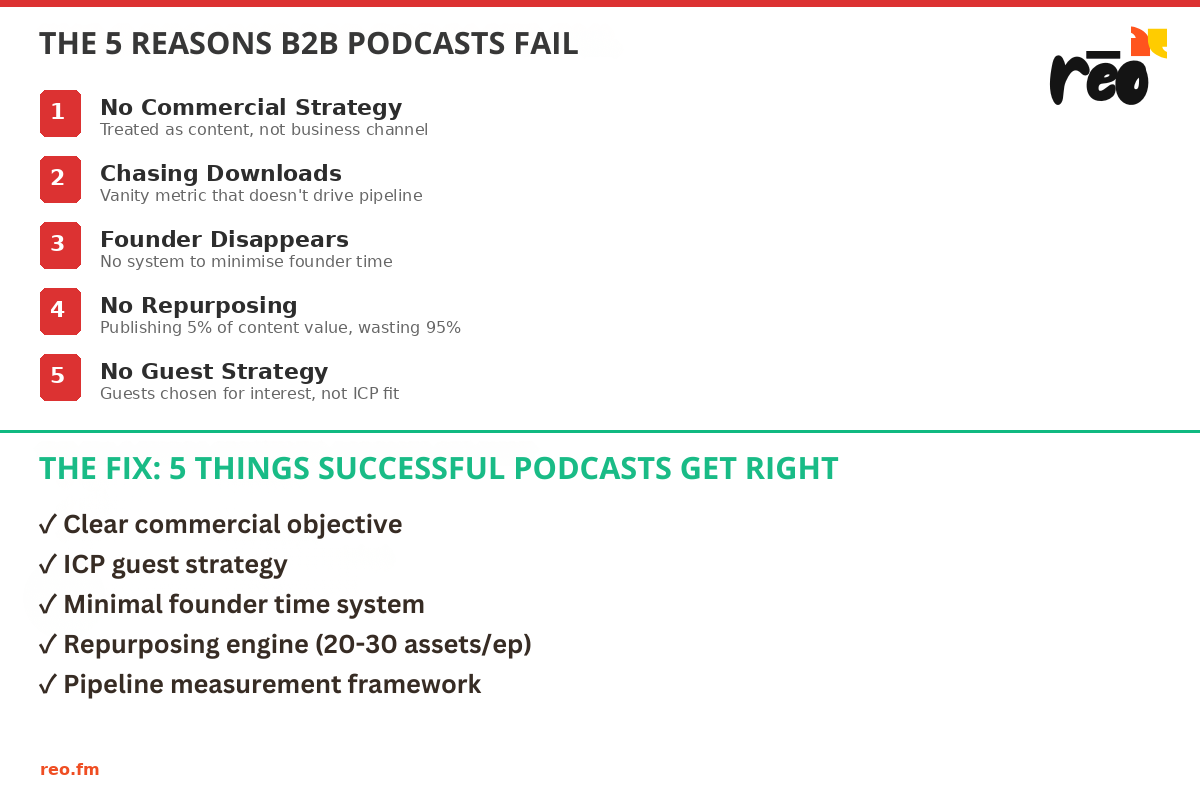
The Pattern Behind Every Failure
Every failed B2B podcast shares the same root cause: they treated podcasting as a content format instead of a business channel.
The podcasts that work, the ones that generate $1M+ in pipeline, that become the backbone of a company's GTM strategy, are the ones that started with a clear commercial objective and built every decision around it.
The format isn't broken. The strategy usually is.
What a Successful B2B Podcast Looks Like
A podcast that works has five things in place from day one:
1. A clear commercial objective tied to pipeline, not downloads.
2. A guest strategy built from the ICP, not the founder's contact list.
3. A production system that demands minimal founder time.
4. A repurposing engine that turns every episode into 20+ multi-channel assets.
5. A measurement framework that tracks relationships built and pipeline influenced.
Get these five right, and the podcast becomes the most efficient pipeline channel in your GTM stack. Get them wrong, and you're recording episodes that nobody uses.
Reo.fm helps B2B SaaS companies build podcasts that generate pipeline, not just episodes.
[Book a free strategy session]