
What Is Podcast-Led ABM (And Why It Works Better Than Traditional ABM)

If you’ve worked in B2B SaaS marketing over the past decade, you’ve almost certainly heard this phrase:
“Let’s run an ABM campaign.”
Account-Based Marketing (ABM) became the gold standard for high-value B2B selling. It promised precision, personalization, and pipeline impact.
And to be fair, the idea behind ABM is solid.
But in practice, most ABM programs today are expensive, complex, and increasingly ignored.
There’s a better way to execute the spirit of ABM without the friction. And surprisingly, it looks a lot like a podcast.
Let’s break this down properly.
What Is ABM in B2B SaaS?
At its core, ABM is simple.
Instead of marketing to a broad audience and hoping the right accounts convert, you identify a list of high-value target accounts and market directly to them.
Typical ABM in B2B SaaS includes:
- Identifying 50–500 high-value target accounts
- Running LinkedIn ads specifically targeting those accounts
- Personalized landing pages
- Custom email sequences
- Sales + marketing alignment
- Direct mail campaigns
- Gifting programs
- Event invitations
- Executive roundtables
- Intent data tracking
The logic makes sense.
If you sell a product with ACVs of $50K, $80K, or $200K+, you don’t need millions of leads. You need the right 50 companies.
According to ITSMA, 87% of marketers say ABM outperforms other marketing investments in ROI. That’s why companies have leaned into it heavily.
But here’s the issue.
The way ABM is commonly executed today is becoming noisy and predictable.
The Challenges with Traditional ABM
On paper, ABM is personalized.
In reality, much of it feels automated.
1. Everyone Is Running the Same Playbook
Your ICP is already being targeted by:
- LinkedIn ads
- Sponsored content
- Cold outbound emails
- SDR sequences
- Webinar invites
- Gifting campaigns
When five vendors send similar “personalized” messages in the same week, personalization loses its meaning.
2. It’s Expensive
ABM stacks aren’t cheap.
You’re paying for:
- Intent data tools
- LinkedIn ad spend
- ABM software platforms
- Creative assets
- Sales enablement tools
- Event budgets
For early-stage or mid-stage SaaS companies, ABM can burn budget quickly without immediate results.
3. Buyers Are Tuning Out
B2B buyers have changed.
According to Gartner research, B2B buyers spend only 17% of their buying journey meeting with suppliers. The rest of the time is spent researching independently.
If your ABM strategy is built around interrupting them with ads and outbound, you’re competing in a crowded attention economy.
4. It Lacks Genuine Relationship Depth
True ABM is about building relationships with key accounts.
But ads and emails don’t build relationships.
Conversations do.
And that’s where Podcast-Led ABM enters the picture.
Good Read: From Podcast to Pipeline: How B2B Teams Should Measure Podcast ROI
What Is Podcast-Led ABM?
Podcast-Led ABM is simple in concept:
Instead of targeting your ideal accounts with ads, you invite them into meaningful conversations.
You build relationships before you ever pitch.
Here’s how it works:
1. Identify your ICP and key target accounts.
2. Invite decision-makers, operators, or influencers from those companies as podcast guests.
3. Host a thoughtful, relevant conversation.
4. Turn that conversation into multi-channel content.
5. Follow up naturally after the episode.
That’s ABM done differently.
Not interruptive.
Not automated.
Not transactional.
Just human.
Why Podcasts Are a Powerful ABM Channel
Let’s get specific.
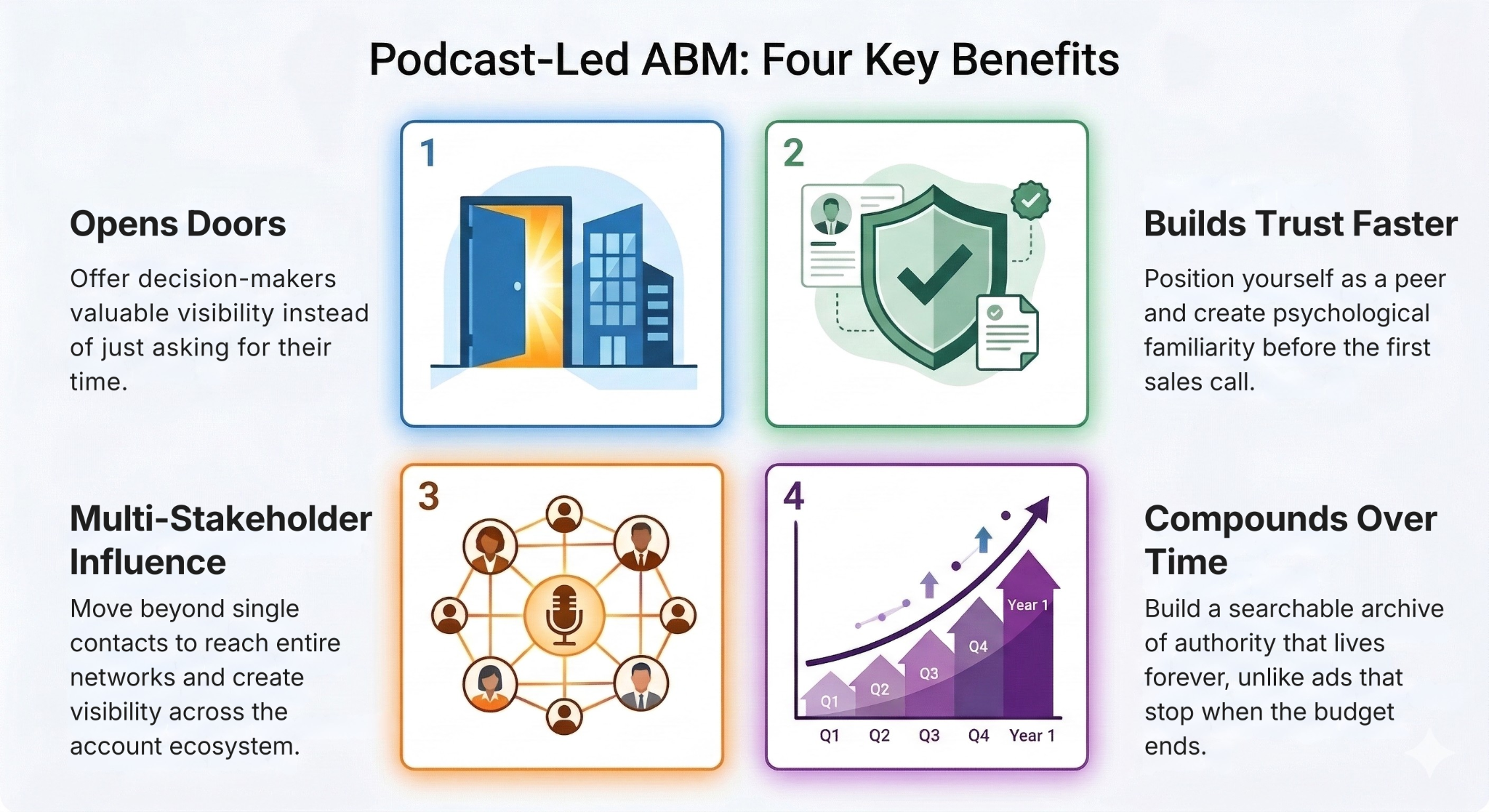
1. It Opens Doors That Cold Outreach Cannot
If you send a cold sales email, you’re asking for time.
If you invite someone as a podcast guest, you’re offering visibility.
That’s a very different dynamic.
People ignore cold pitches.
They rarely ignore opportunities to share their story.
Podcast invitations feel collaborative, not transactional.
2. It Builds Trust Faster
Trust in B2B is everything.
Edelman’s Trust Barometer consistently shows that buyers trust experts and peers more than brand messaging.
A 30-minute thoughtful conversation:
- Positions you as an industry peer
- Demonstrates credibility
- Creates psychological familiarity
- Establishes mutual respect
By the time a sales conversation happens, you’re no longer a stranger.
You’re someone they’ve spoken to.
3. It Creates Multi-Stakeholder Influence
Traditional ABM targets accounts.
Podcast-Led ABM reaches networks.
When your guest shares the episode:
- Their team sees it
- Their peers see it
- Their broader network sees it
You don’t just build a relationship with one contact.
You create visibility across the account ecosystem.
4. It Compounds Over Time
ABM ads stop when budget stops.
Podcast episodes live forever.
Every episode becomes:
- A YouTube asset
- A LinkedIn video
- A newsletter feature
- A sales enablement resource
- A website content piece
Over time, you build a searchable, public archive of authority.
The Bonus: Built-In Content Engine
One of the hidden advantages of Podcast-Led ABM is that it solves another major marketing problem.
Consistency.
Most B2B SaaS teams struggle with maintaining a consistent content calendar.
With a podcast, your content calendar becomes structured.
Each episode generates:
- 1 full-length video
- 1 audio episode
- 5–15 short-form clips
- 2–3 LinkedIn posts
- A newsletter
- A blog article
- Quote graphics
- Sales snippets
And here’s the key:
Video performs better than text in today’s social algorithms.
LinkedIn has leaned heavily into native video.
YouTube Shorts continues to grow.
Short-form vertical content dominates attention.
Instead of scrambling for ideas, your content is anchored around real conversations with real industry leaders.
You’re not manufacturing thought leadership.
You’re capturing it.
Good Read: Turn Your Podcast Into a Pipeline: Generating 30+ Assets for LinkedIn, Email, and Sales
Why Podcast-Led ABM Works Especially Well in B2B SaaS
B2B SaaS deals are complex.
They involve:
- Multiple stakeholders
- Long buying cycles
- Budget approvals
- Technical evaluations
You need more than awareness.
You need familiarity.
Podcast-Led ABM supports:
- Top-of-funnel visibility
- Mid-funnel relationship building
- Bottom-of-funnel trust acceleration
It doesn’t replace outbound or paid channels.
It enhances them.
When a prospect receives a follow-up email that includes:
“By the way, here’s the episode we recorded together.”
The dynamic changes.
Sales conversations become warmer.
Cycles shorten.
Resistance drops.
How Reo Helps B2B SaaS Companies Execute Podcast-Led ABM
At Reo, we don’t position podcasts as a vanity channel.
We design them as revenue engines.
Here’s what that means in practice.
1. Strategic ICP Mapping
We help define:
- Who should be invited
- Which accounts matter
- What themes align with revenue goals
- How episodes support GTM priorities
This is not “let’s talk to interesting people.”
It's a structured guest strategy.
2. Conversation Design
Every episode is intentional.
We structure conversations to:
- Surface real insights
- Position the host as credible
- Highlight shared industry challenges
- Create natural follow-up opportunities
The goal isn’t downloads.
It’s relationship depth.
3. Production & Quality Standards
We ensure:
- High-quality audio and video
- Strong editing
- Compelling hooks
- Short-form optimization
- Multi-platform distribution
If you’re going to use a podcast as an ABM channel, it must reflect premium positioning.
4. Multi-Channel Repurposing
Each episode becomes:
- LinkedIn video clips
- Sales collateral
- Newsletter content
- Website assets
- SEO blog posts
This amplifies the impact far beyond the original conversation.
5. Sales Alignment
We work with founders and GTM leaders to:
- Use episodes in outbound
- Reference conversations in follow-ups
- Share clips with key stakeholders
- Embed podcast content into sales decks
Podcast-Led ABM only works when marketing and sales are aligned.
The Bigger Shift: From Interruption to Invitation
Traditional ABM often interrupts.
Podcast-Led ABM invites.
It shifts the dynamic from:
“Can we get 30 minutes to sell you something?”
To:
“Let’s have a meaningful conversation about your industry.”
That subtle difference is powerful.
It creates:
- Mutual respect
- Shared visibility
- Long-term brand equity
- Pipeline that feels earned, not forced
The Future of ABM
As B2B buyers become more selective and more resistant to interruptive tactics, marketing must evolve.
The companies that win in 2026 and beyond will:
- Build authority, not just campaigns
- Create conversations, not just ads
- Invest in trust, not just impressions
Podcast-Led ABM sits at the intersection of all three.
It’s not a replacement for your entire GTM engine.
But it may become the most human and effective channel inside it.
And when executed with intention, it doesn’t just generate content.
It generates relationships.
And relationships drive revenue.